What is Educational Omics?
Inspired by the "-omics" paradigm in biomedical sciences (genomics, proteomics, metabolomics), Educational Omics treats learning as a multi-dimensional dynamic system rather than a single score, click stream, or correctness rate.
Educational Omics is the theory, the Educational Omics Data Lake is the methodological infrastructure, and Uedu is the living platform through which the theory and methods are operationalized in real educational settings. Educational Omics 是理論框架,Educational Omics Data Lake 是方法與資料基礎設施,Uedu 則是真實教育場域中持續運作的研究平台,負責將六維度學習資料轉化為可分析、可回饋、可驗證的教學與研究證據。
Together, the three layers form an educational data infrastructure — accumulating data over time, supporting cross-course and cross-institution research, and operating with de-identification, API / MCP maintenance, and AI compute as standing capabilities (see Uedu Labs). MMLA is the inherited method family providing multimodal data collection and analysis; Educational Omics organizes those methods around six theoretically motivated dimensions; Uedu is the living research testbed that runs the whole stack in classrooms.
For a comprehensive technical description with platform implementation details, see the full framework page on Uedu.
The Uedu Educational Omics Research Stack
Theory · Method / Infrastructure · Platform / Testbed — three layers, one accumulating research lineage
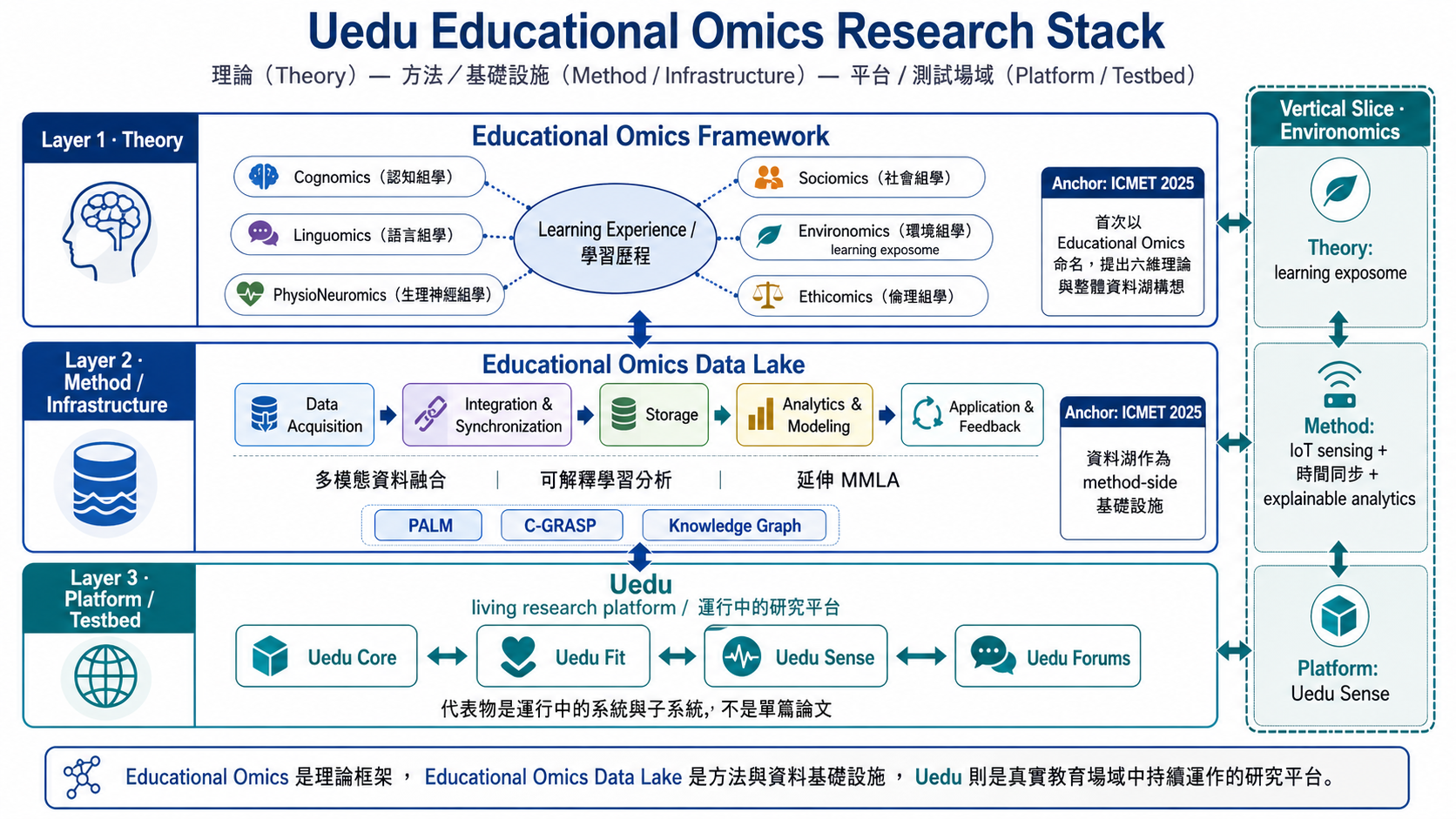
Theory / Educational Omics Framework
Naming and theorization. Educational Omics organizes learning into six theoretically motivated dimensions — cognitive, linguistic, physiological/neural, social, environmental, ethical — treating learning as a multi-dimensional dynamic system rather than a single score, click stream, or correctness rate.
這一層的核心貢獻是命名與理論化:把學習組織為認知、語言、生理/神經、社交、環境、倫理六個理論性維度,建立可被學界引用、延伸與檢驗的研究框架。
Method / Infrastructure / Educational Omics Data Lake
Not a single method but a growing method family. The data lake architecture — acquisition, integration & synchronization, storage, analytics & modeling, application & feedback — extends MMLA with shared schemas, validated algorithms, and explainable models across the six dimensions.
這一層是逐步長出的方法家族:資料湖負責蒐集、同步、保存、分析與回饋;後續論文(PALM、C-GRASP、knowledge graph、temporal lag、digital twin 等)皆作為六維度或跨組學的方法實作模組逐步加入。
Platform / Testbed / Uedu as the living system
Not a paper but a living research testbed. Uedu and its subsystems run in real classrooms — AI dialogue, learning activities, surveys and assessments, classroom events, physiological streams, a data lake, and research ethics workflows — accumulating data across courses and institutions over time.
這一層的代表不是論文,而是 Uedu 持續運作的真實系統與教學現場資料;不應被描述為產品或網站,而是 living research testbed 與 operational research infrastructure。
ICMET 2025 bridges theory and method: it names the Educational Omics framework (Layer 1) and proposes its data-lake instantiation (Layer 2) in the same paper. Subsequent method papers therefore do not redefine the framework — they implement specific omics dimensions or cross-omics fusions inside it, letting the research lineage accumulate rather than fragment.
ICMET 2025 同時命名 Educational Omics 理論並提出其資料湖實作,是 Layer 1 與 Layer 2 的橋接論文。後續方法論文不必重新定義整個框架,而是作為 Educational Omics Data Lake 中某個維度或跨組學的方法實作,使系列研究可以累積而非分散。
Each new omics dimension is designed as a vertical slice traversing all three layers — theory definition (Layer 1) + method contribution (Layer 2) + platform carrier (Layer 3) — rather than as a separate branch. Environomics, for example, is reframed as the learning exposome (Layer 1), instrumented through IoT environmental sensing, temporal synchronization, and seat-level exposure modeling (Layer 2), and carried by Uedu Sense in real classrooms (Layer 3).
每一個新的組學維度都應設計為貫穿三層的 vertical slice:理論定義(Layer 1)+方法貢獻(Layer 2)+平台載體(Layer 3),而不是另開分支。例如 Environomics 升級為 learning exposome(Layer 1),由 IoT 環境感測、時間同步、seat-level exposure 建模實作(Layer 2),並由 Uedu Sense 在真實課堂中承載(Layer 3)。
Six Dimensions
Each dimension captures a distinct facet of the learning experience
Cognomics
Cognitive processes traced through AI dialogue, Bloom's Taxonomy assessment, and learning trajectory analysis.
透過 AI 對話軌跡、Bloom 認知層次評估與學習軌跡分析,追蹤認知歷程。
PhysioNeuromics
Physiological and neural time-series — beat-to-beat intervals, heart rate variability, sleep, EEG, fNIRS — analyzed as correlates of learning states with validated, transparent algorithms.
生理與神經時間序列——BBI、心率變異度、睡眠、EEG、fNIRS——透過具驗證程序與可解釋演算法分析其與學習狀態的關聯。
Sociomics
Social interaction patterns including discussion engagement, collaborative learning, and peer assessment.
社會互動模式,包含討論區參與、協作學習與同儕評量。
Environomics
The learning exposome — the totality of environmental exposures and contextual conditions a learner experiences during a learning event — across four sub-layers: indoor environmental quality (light, temperature, humidity, noise, CO₂, air), spatial and equipment conditions, temporal and activity context, and external environmental context.
學習暴露組(learning exposome)——學習者在學習事件中所承受的環境暴露與情境條件總和——含四個子層次:室內環境品質(光照、溫濕度、噪音、CO₂、空氣品質)、空間與設備條件、時間與活動情境、外部環境脈絡。
Linguomics
Language expression analysis — complexity, semantic structure, voice features — from speech and text.
語言表達分析——語言複雜度、語意結構、語音特徵——來自語音與文本。
Ethicomics
Ethical governance — IRB approval, informed consent, privacy protection, AI bias detection.
倫理治理——IRB 審查、知情同意、隱私保護、AI 偏誤檢測。
Research Pipeline
From multimodal sensing to personalized learning
Multimodal Sensing
HRV, EEG, fNIRS, speech, interactions, IoT
Omics Analysis
Six-dimension framework analysis of learning
AI Integration
Uedu platform integration, contextual support
Adaptive Intervention
PALM model real-time adaptive scaffolding
Personalized Learning
Learner-centered massive personalization
Platform Implementation
Each dimension maps to a subsystem on the Uedu platform
Uedu Core → Cognomics
ClassroomGPT, Quiz, Survey
Uedu Fit → PhysioNeuromics
Garmin, EEG, fNIRS
Forums → Sociomics
Discussion, Peer Assessment
Uedu Sense → Environomics
IoT sensors, STDB
Recordings → Linguomics
Speech, Subtitles, Text
IRB + Consent → Ethicomics
Privacy, Bias Detection